



Windows for Buckinghamshire Homes: A Guide by House Type
The right windows for your home depend more on when and how it was built than on anything else. Buckinghamshire runs from the 1960s and 1970s new city of Milton Keynes and Victorian railway town of Wolverton, through Aylesbury's overspill estates and High Wycombe's furniture-town terraces, to the Georgian market towns and Metro-land estates of the Chilterns.
This guide sets out the main types of home across the county, where each is most common, and the windows and doors that suit it best. It also covers the conservation area and Article 4 rules in Buckinghamshire and Milton Keynes, and the Chilterns National Landscape.
Aliluxe designs, supplies and installs aluminium, uPVC and timber windows and doors across Buckinghamshire, including Milton Keynes, Aylesbury, High Wycombe, Chesham, Amersham and Marlow. Every recommendation here comes from what we see on surveys.
Medieval and Georgian market towns
Buckinghamshire's old towns have timber-framed houses, many refronted in brick in the 18th and 19th centuries, and in Buckingham and Stony Stratford the Georgian fronts went up after fires.
Where you'll find them
Aylesbury: timber-framed buildings in the old town were refronted in brick during the 18th and 19th centuries, behind Georgian facades with wooden sashes.
Buckingham: a fire in 1725 destroyed 138 houses, and many earlier buildings now have Georgian fronts. Of its 192 listed buildings, 80 date from the 18th century.
Amersham, Beaconsfield and Chesham: Amersham's High Street is lined with 16th- to 18th-century buildings and the Market Hall of 1682. Beaconsfield's old town dates from the 16th and 17th centuries, refronted in Georgian brick in the coaching era. Chesham has many 17th-century houses in Church Street and Germain Street.
Marlow, Stony Stratford and Olney: a medieval street pattern with fine Georgian buildings in Marlow, Georgian facades on Stony Stratford's High Street after 18th-century fires, and 17th- and 18th-century stone houses around Olney's market place.
What the windows are usually like
Painted timber sliding sashes on Georgian fronts. Stony Stratford's Bull Hotel has 24-over-24 sashes.
Flush timber casements, and diamond or square leaded lights on some early buildings, such as Buckingham's Old Gaol and Old Latin School.
Local red brick, flint and stone, with Yorkshire sliding sashes on some estate cottages.
What we recommend
Listed buildings need listed building consent for almost any window replacement or alteration. In Buckinghamshire, applications need detailed cross-section drawings, which we can prepare.
Sliding sash windows suit Georgian fronts: timber where the council expects it, and REHAU uPVC sliding sash windows elsewhere.
Secondary glazing is often the best upgrade for listed homes. In Buckinghamshire Council's area, the council says it doesn't need listed building consent, as long as it doesn't alter the existing frames or stop shutters working, and its bars line up with the existing glazing bars.
On older cottages, timber or flush casement windows are the closest match.
Victorian and Edwardian railway and industrial towns
The railway reached Wolverton in 1838, when the railway company set up its engine works there, and Aylesbury in 1839. High Wycombe's population grew from 13,000 in 1881 to 29,000 in 1928, as its furniture trade expanded.
Where you'll find them
Wolverton: a planned railway town with streets at right angles, terraces on Buckingham Street from the 1850s, and late Victorian and Edwardian terraces in brick and Welsh slate.
High Wycombe: artisan terraces built for the chair factories, and Victorian Gothic and Edwardian houses around Priory Avenue and the substantial villas of Amersham Hill.
Aylesbury and Chesham: late 19th- and early 20th-century terraces on Granville and Ripon Streets in Aylesbury, and Broad Street in Chesham, built in 1886, three years before the Metropolitan Railway reached the town in 1889.
Newport Pagnell and Bletchley: Victorian streets such as Silver Street in Newport Pagnell, and estate cottages of 1889 and 1908 near Bletchley Park.
What the windows are usually like
Timber sliding sashes, often with bay windows. In Wolverton the originals were "timber sliding sash, many still survive".
Sashes or side-hung casements on High Wycombe's Victorian and Edwardian houses.
Decorative brick and terracotta details around the windows.
What we recommend
Sliding sash windows keep the original look: REHAU uPVC sliding sash windows, or timber where the council requires it.
For bays, keep the sash style across all faces, or use REHAU bay windows.
In Wolverton, check first: its Article 4 direction covers changes to windows on the front of houses (see below).
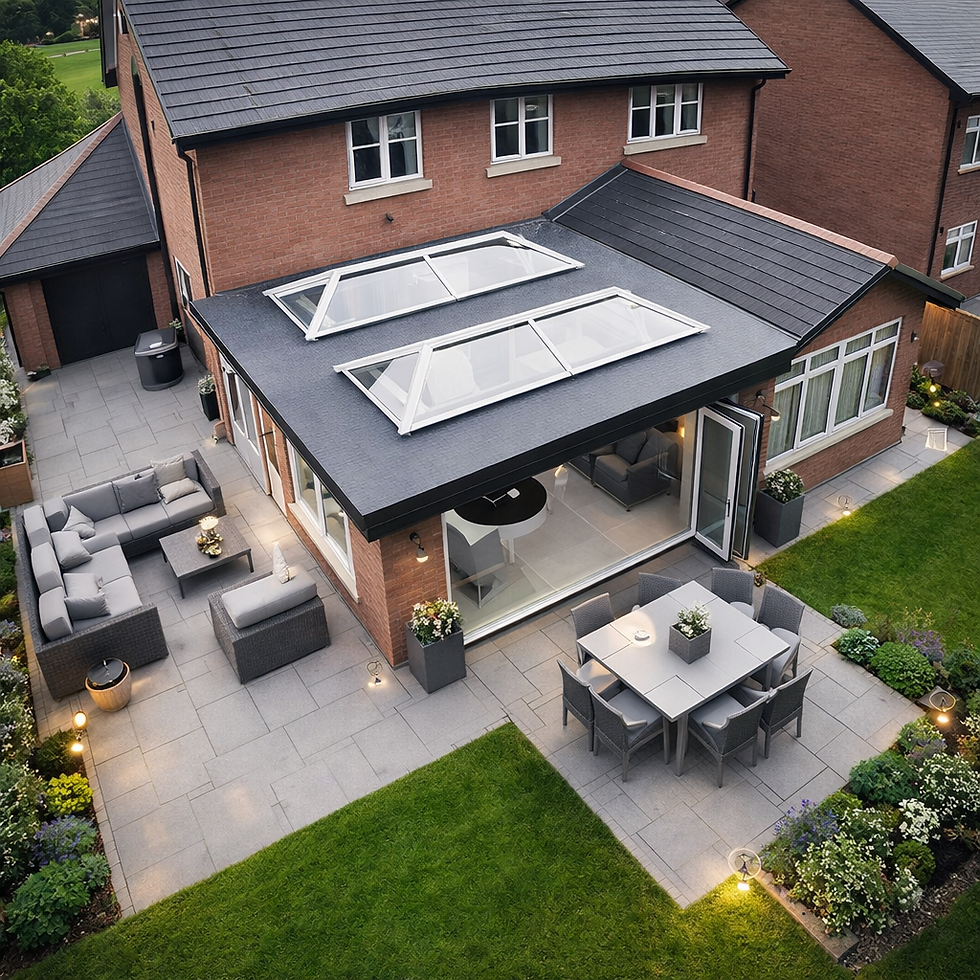
At the back, a kitchen extension with aluminium bi-fold or sliding doors is the most common upgrade we fit.
Edwardian Arts and Crafts houses and Metro-land
Two railways shaped south Buckinghamshire in very different ways. The line through Gerrards Cross opened in 1906 and brought large Edwardian Arts and Crafts houses, while the Metropolitan Railway reached Amersham in 1892 and led to the Metro-land estates of the 1920s and 1930s.
Where you'll find them
Amersham-on-the-Hill: over 2,300 houses built between 1921 and 1931, including the Weller Estate of 1930, the last of the Metro-land estates.
Gerrards Cross: Edwardian roads such as Orchehill Avenue and Latchmoor Grove, on the Orchehill Estate bought in 1905, with more building from the 1920s.
Beaconsfield: early 20th-century Arts and Crafts houses on Park Lane, and early council houses at Malthouse Square, first occupied in 1922.
What the windows are usually like
Casements, often with the upper sections divided into several panes, sometimes painted in two colours (Gerrards Cross).
Oriel windows, half-timbered gables and long stained-glass staircase windows.
Metal Crittall frames on some 1920s houses, such as Malthouse Square in Beaconsfield, though most of the originals there have since been replaced.
What we recommend
Casement windows with the original pane pattern suit these houses best. REHAU uPVC casement windows are good value, and Origin OW-80 aluminium gives a slimmer, flush finish.
Where the originals were steel, heritage steel-look windows recreate the thin Crittall sightlines.
In conservation areas like Gerrards Cross and Beaconsfield, the council's appraisals single out uPVC as eroding character, so keep the proportions and pane layout of the originals.
Front doors: an oak-look or painted REHAU front door in a cottage style suits most Arts and Crafts houses.
Interwar, post-war and new-town homes
Much of Buckinghamshire's housing is 20th century. Aylesbury was designated for London overspill in the 1950s, and Milton Keynes was designated a new town on 23 January 1967, planned for 250,000 people.
Where you'll find them
Milton Keynes: new-town estates such as Beanhill, Netherfield, Fishermead and Fullers Slade, alongside the older towns of Bletchley, Newport Pagnell, Stony Stratford and Wolverton.
Aylesbury: the large semi-detached Southcourt estate, under construction in 1947, and 1970s housing in Bedgrove.
High Wycombe: early council housing of the 1920s at Terriers and Wycombe Marsh, and interwar semis at Totteridge and Cressex.
Newport Pagnell, Princes Risborough and Buckingham: council homes of 1920 and 1935 and the 1970s–80s Poets Estate in Newport Pagnell, 1930s–40s detached houses on Manor Park Avenue in Princes Risborough, and post-war estates at Mount Pleasant in Buckingham.
What the windows are usually like
Timber or steel casements on interwar semis, often in a two-storey bay.
Simple casements on post-war and new-town houses, many since replaced in uPVC.
First-generation uPVC from the 1980s and 1990s, now reaching the end of its life.
What we recommend
Casement windows suit these houses best: REHAU uPVC casement windows, or Origin OW-80 aluminium for a slimmer, flush finish.
For the bay, REHAU bay and bow windows keep the original shape. Ask about a structural check, as many 1930s bays have no proper lintel.
Upper floors and flats: tilt and turn windows clean easily from inside, and Origin OW-70 slimline gives a modern look with more glass.
At the back, sliding doors or bi-folds open up a post-war or new-town living room to the garden.
Conservation areas, Article 4 and the Chilterns in Buckinghamshire
Before you choose windows, check whether your home is listed, whether it is in a conservation area and whether an Article 4 direction applies.
Most houses, including houses in conservation areas without an Article 4 direction, can usually replace windows without planning permission, as long as the new ones are similar in appearance to the old (Planning Portal).
Flats and maisonettes don't have the same permitted development rights as houses. Identical, like-for-like windows usually don't need permission, but windows that look different may, and if you're a leaseholder you may also need consent from your landlord, freeholder or management company (Planning Portal).
Listed buildings need listed building consent for any significant works, inside or out, including windows (Planning Portal).
An Article 4 direction removes particular permitted development rights, so if it covers windows, even a like-for-like replacement can need an application. The directions we found are listed below.
The Chilterns National Landscape (formerly an AONB) covers part of Buckinghamshire, so check whether your address is inside it. Being in it doesn't on its own stop you replacing windows like for like. Where an application is needed, the Chilterns Buildings Design Guide prefers wooden frames to PVC or aluminium, notes that traditional windows had small panes, and asks for thin glazing bars and a painted finish (Chilterns Conservation Board).
Milton Keynes, Wolverton: an Article 4 direction made in 2003 covers changes to windows, doors, door surrounds and terracotta mouldings on elevations facing a road, including the side of corner houses. The council's 2009 review says it has successfully defended its position on plastic replacement windows at appeal (Milton Keynes City Council), and its Article 4 guidance says substitute materials such as uPVC won't normally be accepted unless they match the appearance and detailing of the original (Milton Keynes City Council).
Milton Keynes, Olney: an Article 4 direction covers extensions or alterations, porches and painting for all houses, which is likely to include changes to windows, so check with the council, and a second direction covers properties either side of the High Street from Hoppers Hill to the River Great Ouse. For both towns, the council asks whether replacement windows keep the proportions and style of the existing ones (Milton Keynes City Council).
Milton Keynes, elsewhere: there are no Article 4 directions covering windows in Bletchley, Newport Pagnell or Stony Stratford. Where permission is needed, the Bletchley and Newport Pagnell appraisals say officers will not normally support replacing original timber windows, and Stony Stratford's review notes that timber sashes predominate on its High Street (Milton Keynes City Council). Being on the New Town Heritage Register doesn't remove any permitted development rights (Milton Keynes City Council).
Buckinghamshire Council: over 200 conservation areas, and we found no Article 4 directions covering windows. High Wycombe's appraisal says windows should be painted timber, and that UPVC and aluminium are inappropriate in its conservation area (Buckinghamshire Council). Aylesbury's previous (2004) appraisal discouraged double-glazed uPVC windows (the council adopted a new one in July 2026), and Buckingham's 2025 draft appraisal called replacing poor-quality uPVC with timber a positive change (the council adopted the final version in April 2026).
Work done without the right consent can lead to enforcement and the windows being replaced at your cost. We check these rules for every survey, and can help with the application if one is needed.
Buckinghamshire towns at a glance
Town | Population (2021) | Typical housing | Windows that often suit |
|---|---|---|---|
Milton Keynes | 197,354 | New-town estates from 1967, older Wolverton and Stony Stratford | Casements and tilt and turn; timber sash in Wolverton and Stony Stratford |
Aylesbury | 87,967 | Georgian old town, Victorian terraces, overspill estates | Sash in the old town, casements on estates |
High Wycombe | 83,523 | Furniture-town terraces, Victorian villas, interwar semis | Timber sash in conservation areas, casements on interwar houses |
Bletchley | 45,006 | Victorian estate cottages, post-war suburbs | Casements, timber in the conservation area |
Chesham | 23,689 | 17th-century old town, Victorian terraces | Sash, casements |
Amersham | 17,387 | Old town, Metro-land Amersham-on-the-Hill | Sash in the old town, casements in Metro-land |
Newport Pagnell | 15,248 | Georgian and Victorian terraces, interwar and 1970s estates | Sash and casements |
Marlow | 14,644 | Medieval and Georgian town centre | Timber sash |
Buckingham | 14,304 | Older buildings with Georgian fronts after the 1725 fire | Sash, leaded casements on older buildings |
Beaconsfield and Gerrards Cross | 14,146 and 8,115 | Coaching town, Edwardian Arts and Crafts houses | Sash in the old town, multi-pane casements |
Frequently asked questions
Can I fit uPVC windows in a Buckinghamshire conservation area?
Sometimes. If your house isn't listed or covered by an Article 4 direction, you can usually replace windows without planning permission as long as the new ones are similar in appearance to the old, but the council may not accept uPVC as similar to timber. Where permission is needed, councils here generally favour painted timber: High Wycombe's appraisal calls uPVC and aluminium inappropriate, and the Bletchley and Newport Pagnell appraisals say officers won't normally support replacing original timber windows. We check the rules for your street at survey.
Do I need planning permission for new windows in Wolverton?
For windows facing a road, often yes. Wolverton's Article 4 direction covers changes to windows on elevations facing a road, including the side of corner houses, and the council expects replacements to keep the proportions and style of the originals. Windows at the back aren't covered.
What windows suit a Milton Keynes new-town house?
Casements or tilt and turn windows in uPVC or aluminium, keeping the original pane layout. Being on the New Town Heritage Register doesn't remove your permitted development rights, so work that didn't need permission still won't. If your change does need an application, the council will take the building's heritage value into account.
Do I need permission to replace windows in a flat?
Often. Identical, like-for-like replacements usually don't need planning permission, but windows that look different may, and rules vary by council. If you're a leaseholder, check your lease, as you may also need the freeholder's or management company's consent.
Do you cover my part of Buckinghamshire?
Yes. We work across Buckinghamshire, including Milton Keynes, Aylesbury, High Wycombe, Bletchley, Chesham, Hazlemere, Amersham, Newport Pagnell, Marlow, Buckingham, Beaconsfield and Gerrards Cross.
More window guides
We have guides like this for Surrey, Kent, Hertfordshire, Hampshire, Sussex and Berkshire, and for Central, North, South, East and West London.
Get a free survey
Tell us about your home and we'll recommend the windows that suit it, check whether it is listed, in a conservation area or covered by an Article 4 direction, and give you a fixed quote. Call 020 4581 8351, email sales@aliluxe.co.uk or request a quote online. You can also browse our uPVC windows and doors and aluminium windows.
Please note: This guide is for general information only and is not planning, legal or professional advice. Planning rules, Article 4 directions and council guidance change over time, and how they apply depends on your property, so always check with your local planning authority before you start work (and with your landlord, freeholder or management company if you're a leaseholder). Replacement windows and doors must also meet Building Regulations. Historical and local details come from council, Historic England and other published sources and were believed to be correct when this guide was written in October 2026. Aliluxe cannot accept responsibility for decisions made solely on the basis of this guide, and we'll confirm the rules that apply to your home at survey.


Comments